NEWS

Why Visual Positioning UV Printers Are Exploding in Popularity

DATE : Apr 13th, 2026

Introduction: This Is Not a Feature—It’s a Structural Upgrade

The rise of visual positioning UV printers is often explained as a “technological improvement.” That explanation is too shallow.

What is actually happening is a deeper industrial shift:
printing is moving from manual alignment to intelligent perception.

In a world driven by customization, short-run production, and speed, traditional UV printing methods are no longer just inefficient—they are incompatible with modern demand.


1. From Manual Guesswork to Machine Vision Intelligence

At the core of this transformation lies machine vision.

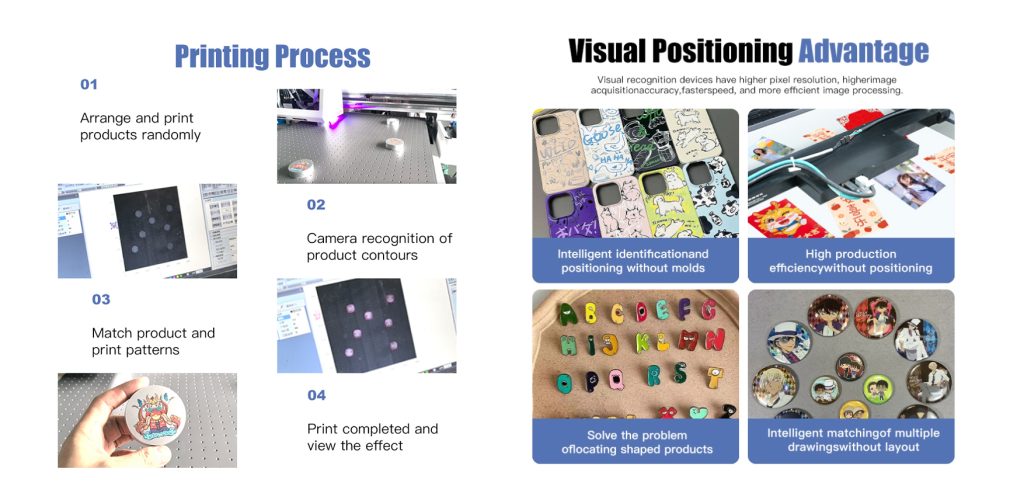
Visual positioning UV printers integrate high-resolution cameras and image recognition algorithms to identify the exact position, angle, and contour of objects in real time, enabling precise alignment without manual intervention.

Traditional logic:

  • Fix the object → adjust the machine

New logic:

  • Place the object → let the machine adapt

Insight:
This reverses decades of manufacturing thinking. Humans no longer “prepare” the process—the system interprets reality directly.


2. Random Placement: The End of Fixtures and Constraints

Fixtures, jigs, and molds have long been considered necessary in UV printing. They are also inefficient.

Visual positioning eliminates them entirely:

  • Objects can be placed randomly
  • The system auto-detects and aligns
  • Setup time drops dramatically

Industry Reality:
Fixtures are hidden costs—design time, storage, wear, and inflexibility. Removing them is not just convenience; it is structural cost reduction.


3. Efficiency Gains Backed by Real Data

Speed is not just about faster printing—it’s about workflow compression.

  • Simultaneous scanning + printing increases throughput by 30–50%
  • Automated positioning reduces manual steps and idle time
  • One operator can manage multiple machines

But the real breakthrough is in waste reduction:

  • Traditional UV workflows can lose 15–20% of materials due to alignment errors
  • Visual positioning can reduce reject rates by up to 80%

Contrarian View:
Most companies believe they have a “printing cost problem.”
In reality, they have a misalignment problem disguised as cost.


4. Precision at Scale: Small Objects, Big Impact

Printing on small or irregular items has always been a bottleneck.

Visual positioning systems solve this by:

  • Detecting micro-level deviations
  • Maintaining consistent alignment across batches
  • Achieving near micron-level accuracy

This unlocks entire markets:

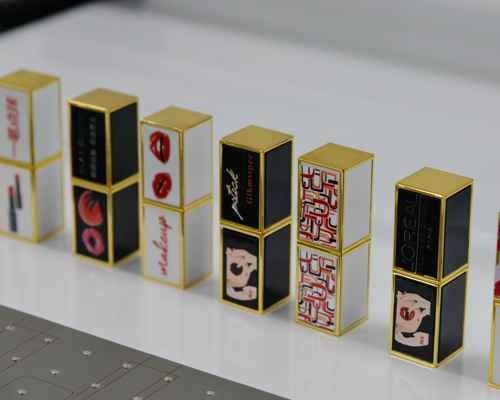
  • Personalized accessories
  • Electronic components
  • Micro promotional products

Key Insight:
The future of printing is not large-format dominance—it is mass micro-customization.


5. Labor Transformation: From Operators to Supervisors

Traditional UV printing:

  • Requires skilled positioning
  • Needs multiple operators
  • Prone to human error

Visual positioning systems:

  • Automate alignment
  • Reduce labor dependency
  • Allow one person to oversee multiple devices

Perspective:
The real disruption is not cost reduction—it is role redefinition.
Labor is no longer physical; it becomes supervisory and digital.


6. Compatibility with the New Manufacturing Economy

Global manufacturing trends are converging around three forces:

  • Short-run production
  • On-demand customization
  • Flexible supply chains

Visual positioning UV printers align perfectly with these trends:

  • Handle irregular objects without reconfiguration
  • Enable rapid switching between orders
  • Support multi-material printing (plastic, metal, glass, wood, etc.)

Big Data Perspective:
The surge in personalized product demand is not a trend—it is a permanent structural shift. Equipment that cannot adapt dynamically will be phased out.


7. Breaking the Old Mental Model

Despite clear advantages, some businesses hesitate to adopt this technology.

Why?

  • Focus on upfront cost instead of lifecycle value
  • Attachment to legacy workflows
  • Underestimation of hidden inefficiencies

Critical View:
The resistance is not technological—it is psychological.
Industries rarely fail because of missing tools. They fail because they refuse to abandon outdated logic.


Conclusion: The Real Reason Behind Its Popularity

Visual positioning UV printers are popular not because they are better machines, but because they align with a new industrial reality:

  • Intelligent instead of manual
  • Adaptive instead of fixed
  • Data-driven instead of experience-dependent

Final Thought:
This technology does not improve printing—it redefines it.

The real question is no longer:
“Should you upgrade to visual positioning?”

But rather:
How long can your business survive without it?
Share:
SERVICE
Provide Thoughtful Solutions To Your Problems
We have a certain scale capacity to ensure your order delivery cycle.
Before Sale Service
Answering consultation from users, according to user's demands, help user choosesuitable type.
During Sale Service
Transport the equipment to user's site safely and timely.
Our technicians guide the operators and maintenance personnel according to theoperating procedures
After Sale Service
Give a clear answer for user's complaints within 24hours.
Return visit at regular intervals.
Establishing user's record.
Providing latest industrial information.
Request A Quote
Complete control over products allows us to ensure our customersreceive the best quality prices and service.

    Name

    *Email

    *Tel/WhatsApp

    Company

    *Messages


    Send Inquiry & Get Quotation
    We will provide you with quality service and guarantee your buying experience
    X
    Contact Us
    Leave your information and requirements, our sales engineer will keep you the updated solutions at your convenient time.